Those orange-brown stains on a Port St. Lucie driveway are almost always caused by iron-rich irrigation water hitting the same spot on the concrete or pavers over and over. Standard pressure washing rinses away surface dirt but usually can't remove the stain itself, because the iron has chemically bonded into the surface — it takes a rust-specific treatment, and the real fix is addressing the sprinkler that's causing it.
What Causes Orange Rust Stains on a Driveway?
Much of the irrigation water used on lawns in this area — whether from a private well or a reclaimed water system — carries a naturally high iron content. Every time a sprinkler head sprays that water onto a driveway, sidewalk, or paver surface, the iron in the water oxidizes on contact and leaves behind a telltale orange-brown residue. It's the same chemistry as a rusting nail, just happening in slow motion, one sprinkler cycle at a time.
Why Some Driveways Get Hit Worse Than Others
Not every property in the same neighborhood ends up with the same staining, and a few variables explain why. Homes on well water tend to see it more than homes on city water, since municipal water is typically treated to remove excess iron before it reaches the tap. Sprinkler head placement matters too — a head aimed directly at a driveway edge or walkway will stain that spot far faster than one aimed only at grass. Irrigation frequency plays a role as well: a zone that runs daily builds up staining faster than one that runs twice a week.
Where These Stains Show Up
Driveways and sidewalks are the most visible, but the same staining shows up anywhere irrigation water repeatedly contacts a hard surface — pool decks, the base of fences, garage door thresholds, and even the lower courses of exterior walls near a sprinkler head. If you're noticing it in one spot, it's worth walking the property to see if it's showing up elsewhere too.
Rust Stains vs. Algae Stains: How to Tell the Difference
Not every dark or discolored patch on concrete is rust. Algae and mold staining — the same buildup that shows up on roofs and shaded walkways — tends to look green-black or grayish and often has a slightly slick or fuzzy texture when it's established. Rust staining is distinctly orange-brown, usually appears as a ring or streak radiating out from a fixed point like a sprinkler head, and feels flat rather than slick. Knowing which one you're looking at matters because they call for different treatments: algae responds to a standard soft wash or pressure wash, while rust needs the acid-based treatment described above. Treating a rust stain like ordinary grime just wastes a cleaning cycle without touching the actual problem.
Will Pressure Washing Remove Rust Stains?
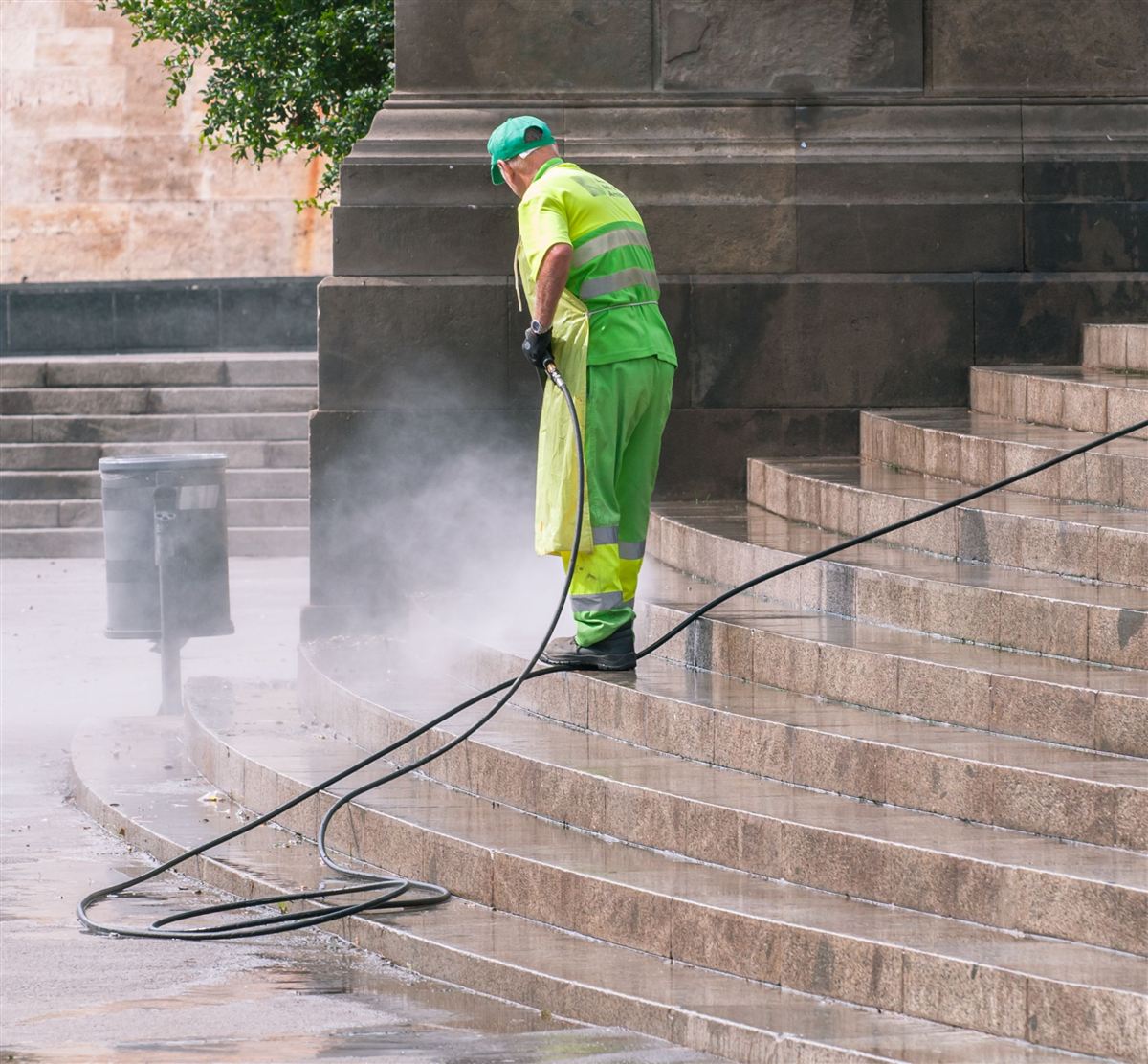
Not on its own. Ordinary dirt and grime sit on top of concrete and pavers, which is exactly what standard pressure washing is built to lift away. Rust is different — the iron oxide bonds chemically into the pores of the concrete or paver surface rather than just resting on it, so water pressure alone typically knocks loose dirt away and leaves the actual stain behind, sometimes making it more visible against a now-cleaner surrounding surface.
What Actually Works
Rust stains need a treatment formulated for the chemistry involved, typically an oxalic-acid-based cleaner designed to break the bond between the iron oxide and the concrete or paver so it can be rinsed away rather than scrubbed off. That treatment is applied in addition to, not instead of, a standard cleaning — the surface still gets washed, the rust treatment targets what the wash alone leaves behind.
How to Stop the Stains From Coming Back
Removing the stain once doesn't stop the sprinkler from re-staining the same spot next season. The most direct fix is adjusting or redirecting the irrigation head so it's watering grass instead of concrete or pavers. For paver surfaces specifically, sealing after cleaning adds a protective layer that makes it harder for iron and other minerals to soak back into the joints and surface — we cover the sealing process in more depth in our paver sealing guide.
Why Timing the Treatment Matters
Rust stains are easier to fully clear the sooner they're treated after they appear. A fresh stain sits closer to the surface, while a stain that's been baking in Florida sun for a year or more has had more time to work deeper into the pores of the concrete or into paver joints, which can mean more than one treatment pass to fully lift it. If a sprinkler head has been hitting the same spot for a long stretch without any cleaning, expect the first treatment to make a real difference without necessarily getting the surface back to its original color in a single visit.
What We Recommend
If you're seeing orange staining on a driveway, walkway, or pool deck, start by checking whether a nearby sprinkler head is aimed at the surface rather than the grass — that's often the fastest lever to pull. From there, a standard cleaning plus a rust-specific treatment addresses the existing stains, and sealing (for pavers) or simply redirecting irrigation keeps new ones from setting in. Trying to blast rust out with pressure alone usually just wastes water and time without touching the actual stain. And if what you're actually seeing is green-black buildup rather than orange staining, that's more likely algae than rust — see our guide on how often surfaces need cleaning in Port St. Lucie's climate.
JB Powerwash Services handles driveway and concrete pressure washing, plus paver cleaning and sealing, for properties across Port St. Lucie and St. Lucie County — call for a free estimate and we'll take a look at what's actually causing the staining.