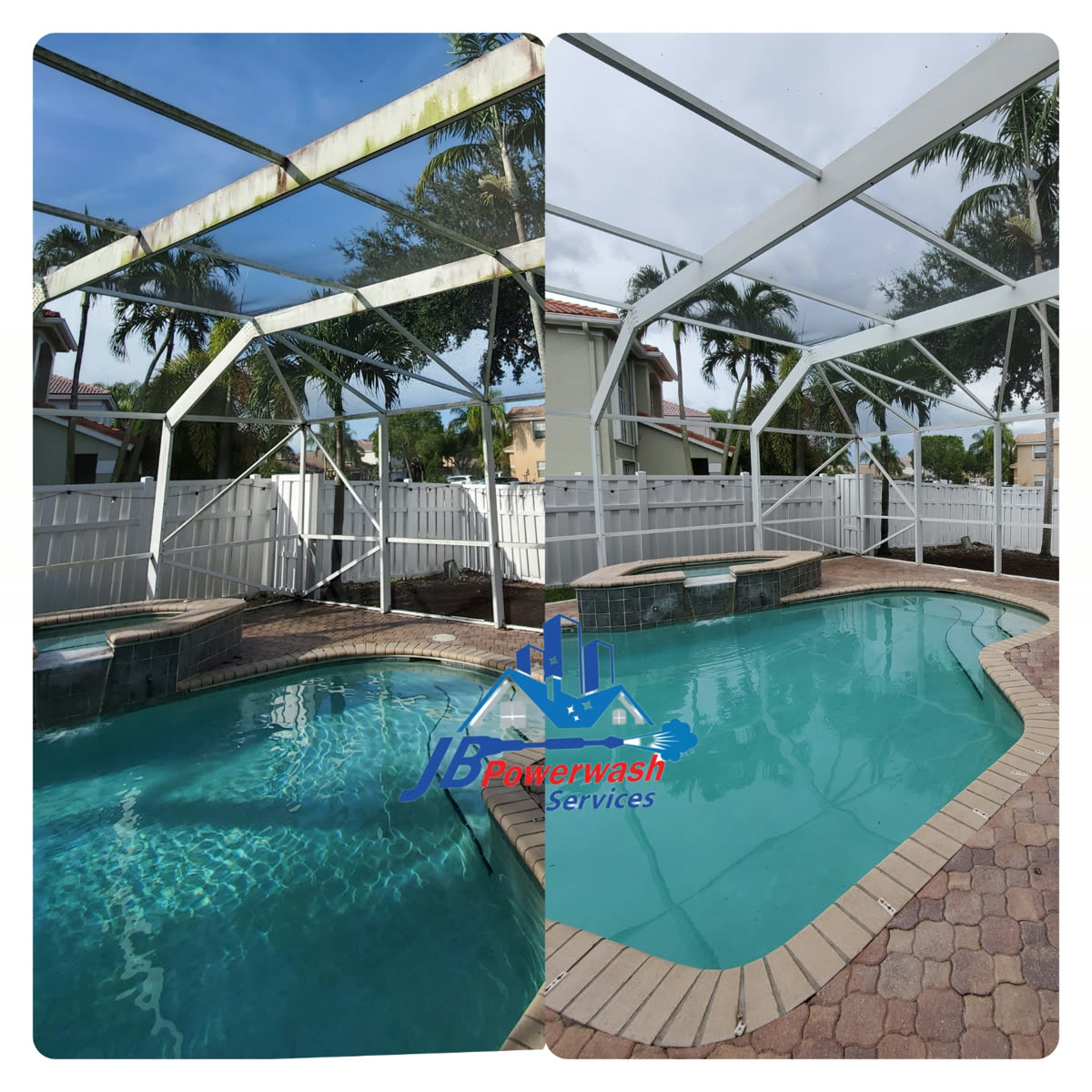
There is no fixed calendar for cleaning pool screens. Clean them when you see a gray or green haze on the mesh, sprinkler spotting low on the panels, or aluminum that stays dull after a hose rinse. Those signs tell you more than a date on the calendar.
JB Powerwash Services is based in Port St. Lucie, FL, and our pool cage and lanai cleaning follows these same signs. Below is how to read each one, what changes how soon a cage needs attention, and what you can check before you call.
Is there a fixed schedule for pool screen cleaning?
No. Every lanai is different, so the condition of the screens is a better guide than a set number of months.
A cage under oak trees, next to a pond or near a sprinkler line collects dirt and growth faster than one in an open yard. Two neighbors on the same street can have very different screens. That is why we look at what is on your cage instead of handing out one schedule for everyone.
Use the three signs below as your checklist. If you see one, the cage is likely due. If you see two or more, do not wait.
What does the haze on the mesh mean?
A gray or green haze building on the screen mesh means dirt, pollen, algae or mildew is collecting on the strands. It usually starts light and builds slowly.
You may not notice it from inside the pool area. Stand outside the cage on a bright day and look across the screen toward a dark background. A haze or dull film on the mesh shows up clearly from there.
Here is what the haze can do if left alone:
- It blocks light and makes the lanai feel darker.
- It dulls the view of your yard.
- It gives algae and mildew a place to keep growing.
- It can turn a light film into a black coating over time.
For more on dark growth, see our article on pool cage cleaning in Port St. Lucie.
Why do the lower panels get spotted?
Lower panels get spotted because sprinklers reach them. The water carries minerals, and when it dries on the framing it leaves white or cloudy marks.
Look at the aluminum low on the cage, close to the ground. White or cloudy sprinkler spotting low on the framing is the second sign that cleaning is due. The spots often form a pattern that follows the sprinkler spray.
These marks can build up over many watering cycles. The longer they stay, the harder they are to remove. If you can adjust your sprinkler heads so they do not hit the cage, that helps slow the spotting.
What about aluminum that looks dull?
Dull aluminum that stays dull after a hose rinse is the third sign. If a rinse brightens the frame for a moment but the dullness returns as it dries, the film is stuck on the surface.
Try it yourself on a small section. Rinse it with a garden hose and watch as it dries. If the metal looks chalky or flat compared with a spot that was just wet, the frame needs more than water.
Do trees and sprinklers change how soon you need it?
Yes. Trees, shade, sprinklers and nearby water all speed up buildup.
Here is how to judge your yard:
- Trees overhead or beside the cage: leaves, pollen and sap land on the screens.
- Heavy shade: damp, shaded screens grow algae and mildew faster.
- Sprinklers that reach the cage: spotting returns each time they run.
- Ponds or other water nearby: moisture in the air feeds growth.
- Open, sunny yards: screens tend to stay cleaner for longer.
If your yard matches several of these, check your screens more often. We serve Port St. Lucie and St. Lucie County, including Tradition, St. Lucie West, Fort Pierce, Stuart, Palm City and Jensen Beach, and we see these patterns in each of them.
What should you check yourself before calling?
Do a quick walk around the outside of the cage in good daylight. It takes a few minutes and tells you what you are dealing with.
- Look at the mesh from outside against a dark background for a gray or green haze.
- Check the lower frame for white or cloudy sprinkler marks.
- Rinse a small patch of aluminum and see if it still looks dull.
- Look at the top of the cage and the corners, where debris collects.
- Note which sprinklers and trees are close to the cage.
Please do not climb on the cage or scrub it hard yourself. Screens tear easily, and a rough brush can push dirt into the mesh. Gentle methods protect the screens, and we use soft washing for delicate surfaces.
When is it time to call?
Call when you see any of the three signs and a rinse does not fix it. Call sooner if the cage is covered in dark growth, or if you want it clean before guests, a sale or storm season.
A short description helps. Tell us how big the cage is, which signs you see, and where the trees and sprinklers are. We will look at the details and talk through the right approach.
Want your pool cage checked? Contact JB Powerwash Services for a free estimate at 954-652-9551.
Frequently Asked Questions
Can I clean pool screens with a garden hose?
A hose rinse removes loose dust and helps you test the aluminum. It usually will not remove haze, algae or sprinkler spotting. Avoid scrubbing hard, because screens tear easily.
Is a pressure washer safe for pool cage screens?
Strong spray can stretch or tear mesh and bend thin framing. A gentler soft-washing approach is a better fit for screens and other delicate surfaces. Ask any company how they protect the mesh.
Does cleaning the screens help the pool stay cleaner?
Clean screens let more light through and shed less dirt and debris into the pool area. They will not replace regular pool care, but they remove one source of mess.
Does JB Powerwash Services clean lanai ceilings and frames too?
Our pool cage and lanai cleaning covers screens and framing. Describe your lanai when you call for a free estimate, and we will confirm what is included for your setup.